Forklift transport in Los Angeles requires more than an available truck. The forklift must be measured and weighed, matched to the correct trailer, loaded with the right method, secured at approved points, and routed for its actual loaded dimensions.
IZ Freight coordinates forklift shipping throughout Southern California, nationwide, and to or from the Ports of Los Angeles and Long Beach. We arrange equipment for warehouse forklifts, rough-terrain forklifts, telehandlers, reach stackers, and high-capacity industrial units.
Who Uses Forklift Transport in Los Angeles?
Forklift shipping supports businesses that buy, sell, rent, relocate, import, or export material-handling equipment. Los Angeles demand spans ports, warehouses, construction sites, studios, factories, and distribution centers.
- Forklift dealers, rental yards, auctions, and fleet operators
- Warehouses, fulfillment centers, cold-storage facilities, and third-party logistics providers
- Manufacturers, aerospace suppliers, machine shops, and food processors
- Construction, lumber, steel, recycling, agriculture, and building-material companies
- Port terminals, container yards, intermodal facilities, and marine contractors
- Film studios, event companies, data-center contractors, and industrial installers

Which Trailer Is Best for Shipping a Forklift?
The best trailer depends on total weight, overall height and width, ground clearance, attachment configuration, and whether the forklift can safely drive. Exact specifications must be confirmed before equipment is dispatched.
| Forklift or condition | Possible equipment | Planning concern |
|---|---|---|
| Warehouse or pneumatic forklift | Hotshot, flatbed, or step deck with ramps | Ramp rating, deck capacity, height, and ground clearance |
| Tall-mast industrial forklift | Step deck, double drop, or lowboy | Loaded height after the mast is fully lowered |
| Telehandler or rough-terrain forklift | Step deck with ramps, RGN, or lowboy | Width, tire placement, attachment, and axle weight |
| High-capacity forklift or container handler | RGN, lowboy, or multi-axle configuration | Permits, route, escorts, axle distribution, and loading support |
| Non-running or damaged forklift | Trailer matched with winch, crane, or rigging plan | Brakes, steering, rolling condition, and recovery access |
Review IZ Freight’s open-deck trailer types and specifications for general equipment comparisons.
Forklift Flat-Rack Shipping Through Los Angeles Ports
An ocean flat rack is used for out-of-gauge cargo that cannot fit inside a standard container. It is different from a highway flatbed trailer and requires approval, preparation, and coordination with the ocean carrier, terminal, and inland transport provider.
- Booking details: Confirm the forklift’s actual dimensions, weight, center of gravity, lifting points, and selected flat-rack size.
- Preparation: Lower the mast and attachments, secure movable components, and follow carrier instructions for fuel, batteries, fluids, cleaning, and export documentation.
- Blocking and lashing: A qualified party must prepare the unit for ocean movement using an approved blocking, bracing, and lashing plan.
- Terminal coordination: Confirm delivery order or booking information, terminal cutoff, appointment, access requirements, free time, and any out-of-gauge handling instructions.
- Inland transportation: Plan the flat-rack pickup or delivery, chassis or specialized trailer, crane or lift support, permits, and final destination access.
IZ Freight coordinates Port of Los Angeles and Long Beach freight, including flat racks, breakbulk machinery, and oversized equipment moving to or from inland destinations.
When Is a Forklift an Oversized or Overweight Load?
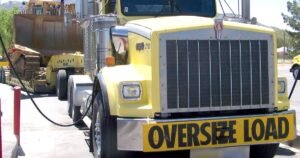
A forklift can require permit review when the loaded combination exceeds legal width, height, length, axle, or gross-weight limits. The unit itself may look compact while its mast, tires, counterweight, attachment, or total mass changes the transportation plan.
The final loaded measurements control the route. Planning can include state and local permits, bridge and roadway review, travel windows, escort vehicles, axle configuration, and restrictions near ports or city streets. Caltrans lists permit categories and application resources, but each shipment must be checked against its actual configuration and route.
For larger units, see IZ Freight’s Los Angeles heavy-haul and oversized freight service.
How Should a Forklift Be Prepared for Transport?
Preparation starts with verified specifications and a clear loading plan. Never rely only on a model’s advertised weight because batteries, forks, clamps, booms, counterweights, and other attachments can change the shipping configuration.
- Provide the data plate, model and serial information, current weight, and dimensions with all attachments included.
- Share recent photos from the front, rear, both sides, operator area, tires, mast, data plate, and any damage.
- Confirm whether the forklift starts, drives, steers, brakes, and can safely climb the proposed ramps.
- Lower and secure the mast, forks, boom, or accessory equipment according to manufacturer instructions and the loading plan.
- Identify battery type, fuel type, fluid leaks, export-cleaning needs, and any hazardous-material questions before pickup.
- Confirm dock, ramp, crane, forklift, or rigging availability at both ends and provide site access details.

How Are Forklifts Loaded and Secured?
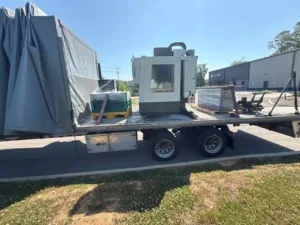
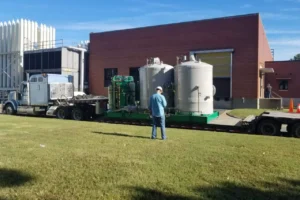
Forklifts may be driven onto rated ramps or an RGN, winched when non-running, or lifted by qualified riggers when drive-on loading is not appropriate. The method must match the machine, site, and trailer.
Federal cargo-securement rules address heavy vehicles and machinery. Equipment weighing 10,000 pounds or more generally requires at least four tiedowns, while accessory equipment must be lowered and secured and articulated units restrained against articulation. Securement must use suitable points and equipment for the specific machine and shipment.
Chains, binders, chocks, blocking, and placement are selected after the carrier reviews the forklift and trailer. Manufacturer-designated tiedown points should be used when provided, and the machine should never be improvised into place without a documented loading plan.

What Must Be Planned at Delivery?
The destination must have enough room, suitable ground conditions, and the correct unloading method. A successful nationwide move can still fail at the final mile if the trailer cannot enter or the receiver cannot unload the forklift.
- Confirm gate width, turns, overhead clearance, pavement or soil conditions, and staging space.
- Identify appointment rules, site contacts, safety orientation, and permitted delivery hours.
- Verify dock height, ramps, crane, recovery equipment, or rigging before the truck arrives.
- Arrange a nearby commercial meeting point when a residential street or restricted site cannot accept the trailer safely.
Forklift Shipping Quote Checklist
Accurate information prevents equipment changes, rejected pickups, permit delays, and avoidable charges. Include the following details with the quote request.
- Pickup and delivery addresses, site contacts, hours, and requested dates
- Year, make, model, serial number, fuel or battery type, and operating condition
- Exact length, width, height, weight, attachment details, and ground clearance
- Loading and unloading method, dock or ramp details, and any required crane or rigging
- Photos from all sides, the data plate, mast, forks, tires, and any damage
- For port freight: booking or delivery order, terminal, container or flat-rack number, cutoff or availability, and customs-release status
Forklift Transport FAQ
These answers cover the questions Los Angeles shippers most often ask before booking a forklift move.