
Why LTL Bills Change After Pickup
LTL reweigh fees and surprise accessorial charges can push an LTL invoice well above the quote. Add a reclass, a missed pickup or a damaged pallet and you have most of the headaches shippers deal with. Almost every one of them starts before the truck shows up, with a number on the quote or the bill of lading (BOL) that does not match the freight on the dock.
The good news is that most of it is preventable. This guide walks through the pain points we see most when serving Los Angeles shippers, what causes each one, and the simple habits that keep your final invoice close to your quote. If you are new to it, our guide to LTL shipping from Los Angeles covers the basics first.
LTL Reweigh Fees and Reclasses: What Triggers Them
A reweigh or reclass happens when the carrier’s measurements do not match your bill of lading. LTL carriers can run freight over scales and dimensioners at the terminal, and when the numbers differ, the bill is usually adjusted to what they found.
Why it happens
- The weight came from a packing list or an old quote, not a scale.
- Dimensions were measured before wrapping, or missed an overhang or a tall item on top.
- The freight description is vague, so the class does not fit what is on the pallet.
- The pallet itself and the wrap were left out of the weight.
How to prevent it
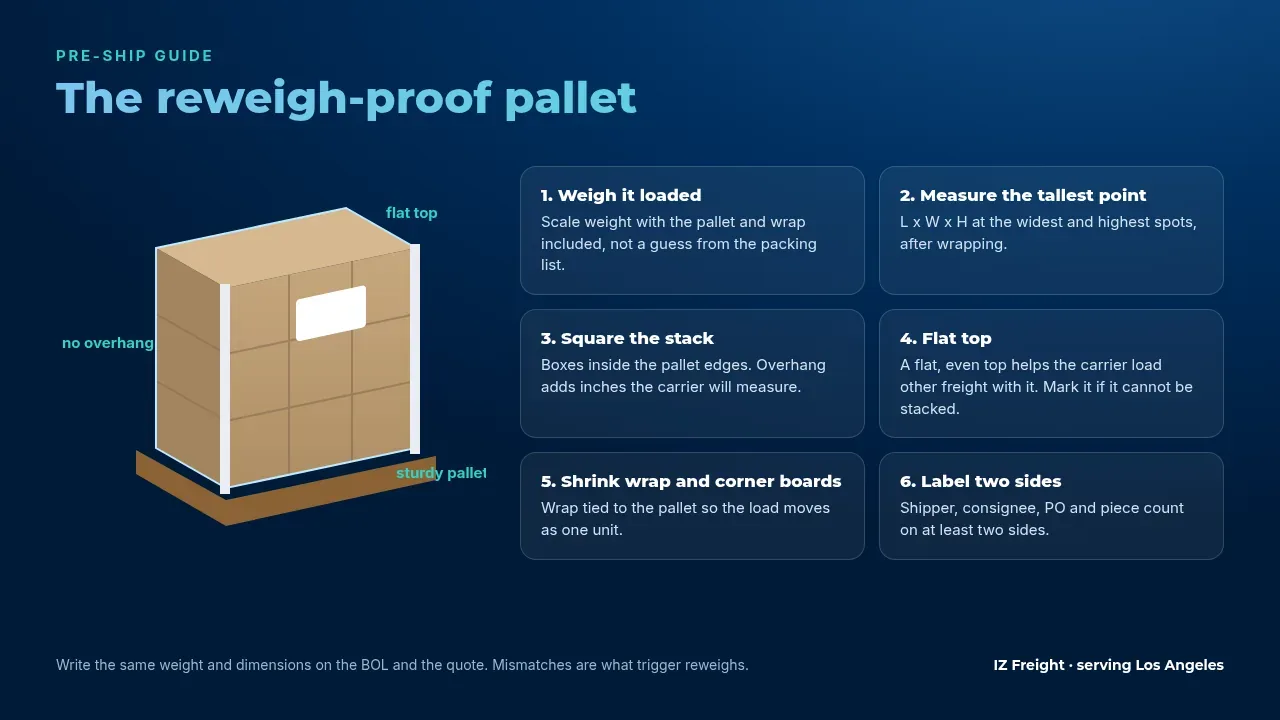
Weigh the loaded pallet, measure the tallest and widest points after it is wrapped, and use the same numbers on the quote and the BOL. A clear description of the product matters too, because the class has to match what is actually shipping.
How Carriers Weigh and Measure Freight at the Terminal
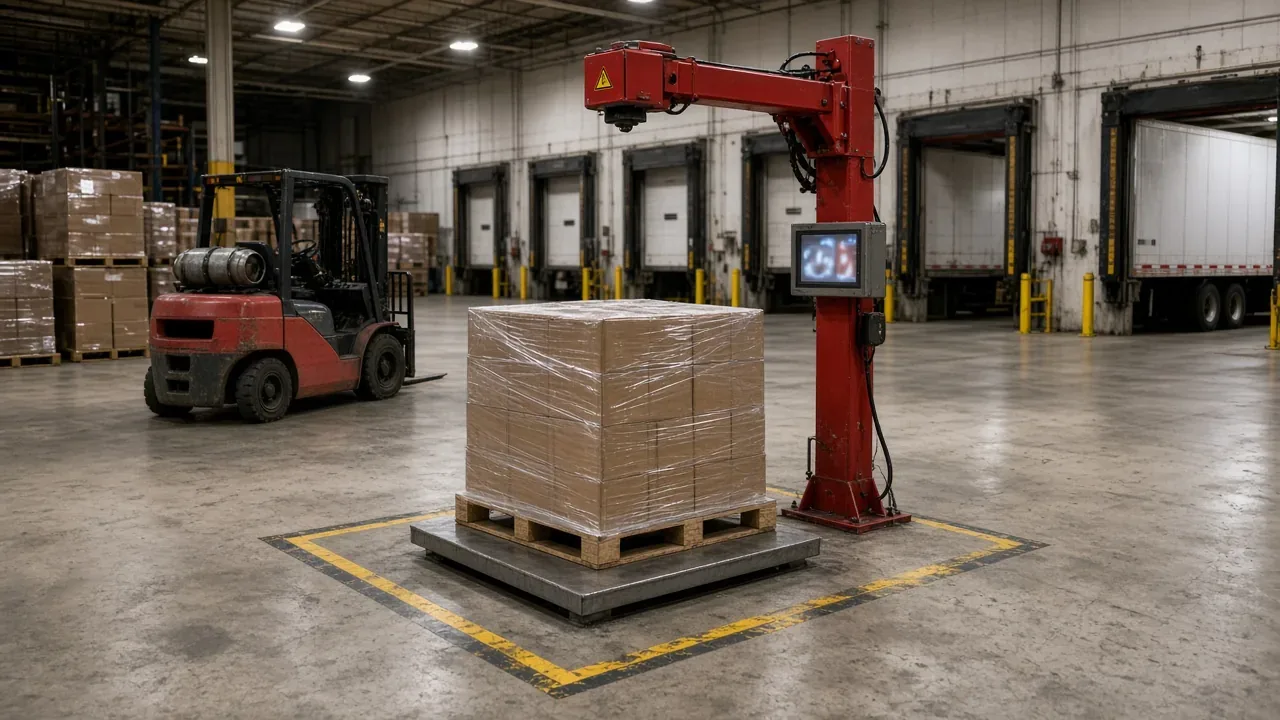
LTL carriers check freight as it crosses their docks, and many terminals do it automatically. What they find on their own equipment is what the bill is usually based on, so it helps to know what they use.
- Floor scales. Platforms set into or onto the dock floor. A forklift sets the pallet down and the weight is recorded.
- Forklift scales. Scales built into the forks or carriage, so a pallet can be weighed while it is being moved.
- Overhead or laser dimensioners. Sensors mounted above a marked zone measure length, width and height, often at the same spot as a floor scale.
- Photo evidence. Many systems take photos of the pallet at the moment it is measured, which can be attached to the correction.
- Inspection or weight and research (W&R) certificates. When a carrier changes weight, size or class, it can usually produce an inspection record showing what it found. Names and formats vary by carrier.
Reweighs and reclasses happen when those numbers do not match the BOL. The carrier then rerates the shipment under its tariff, using its own weight, dimensions or class. Depending on the tariff, a correction or inspection fee can be added on top of the rerated charges.
Freight Class and Density After the 2025 NMFC Changes
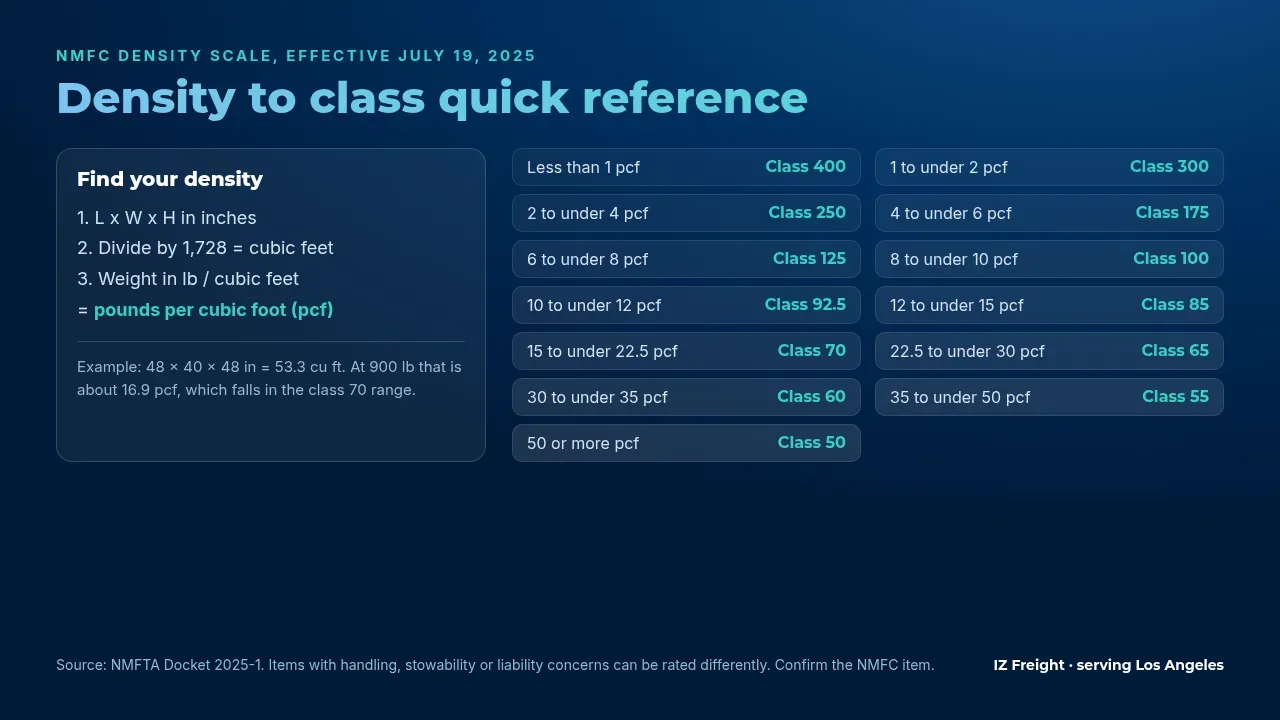
Density now drives class for far more freight than it used to. According to NMFTA, Docket 2025-1 took effect on July 19, 2025, moved more than 2,000 items to density-based classification and replaced the 11-tier density scale with a 13-tier scale.
Density is simple math: multiply length, width and height in inches, divide by 1,728 to get cubic feet, then divide the weight by that number. The result is pounds per cubic foot. Heavier, denser freight generally lands in a lower class, and light, bulky freight in a higher one. Some items still have their own class because of handling, stowability or liability concerns, so the NMFC item number still matters.
If you are not sure of your class, send the weight, dimensions and a product description. We estimate the class and confirm it with you before booking.
Accessorials: The Fees That Show Up Later
Accessorials are charges for anything beyond a standard dock to dock move. They are normal, and they can be priced up front when they are known.
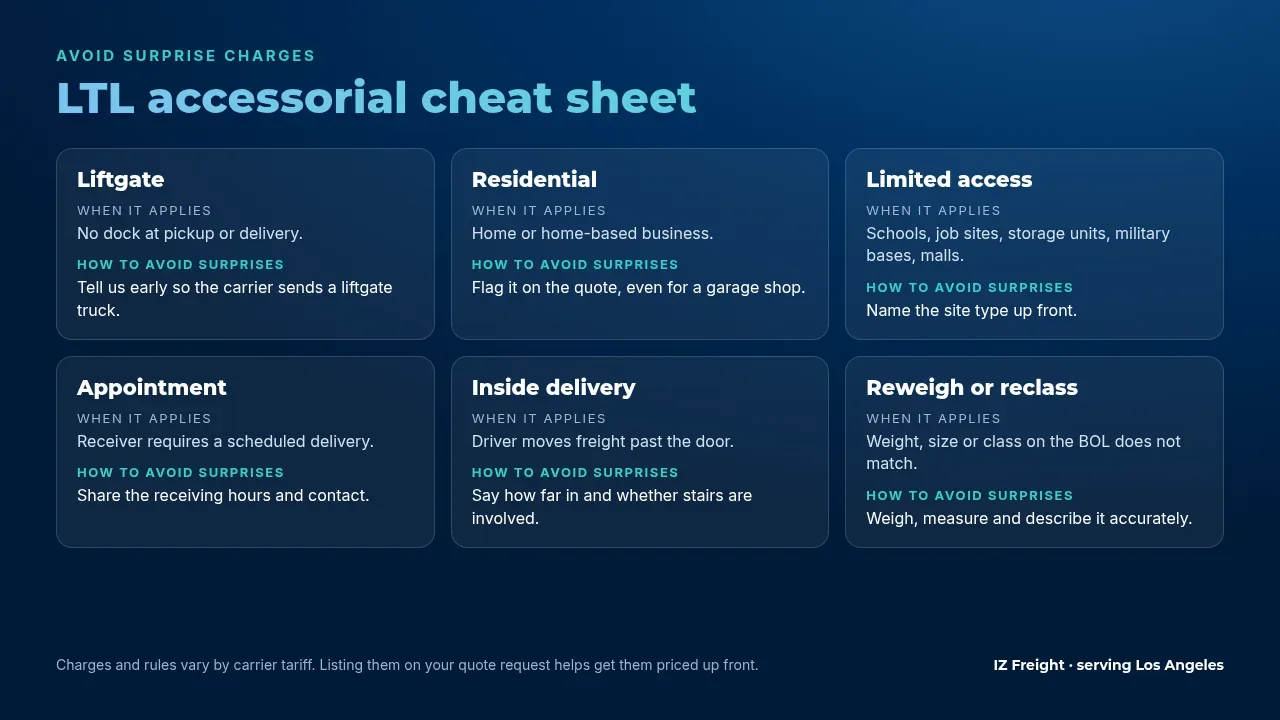
- Liftgate when there is no dock at pickup or delivery.
- Residential for homes and home-based businesses, including garage shops.
- Limited access for sites like schools, construction sites, storage units and military bases.
- Appointment when the receiver needs a scheduled delivery.
- Inside delivery when the driver needs to bring freight past the door.
How accessorials get added after the fact
If a service is not on the BOL, the driver still has to deal with what is in front of them. A delivery that turns out to be residential, a receiver who demands an appointment, a site with no dock, or a consignee who asks for a call before delivery (often called notify) can each lead to an accessorial being added after pickup.
The charge is generally billed at the carrier’s tariff rate, and some tariffs add a correction fee when the BOL has to be changed. A service that was not planned can also mean a second attempt, which may bring a redelivery charge.
Rules and charges vary by carrier tariff. The fix is to describe both ends honestly on your quote request: dock or no dock, business or home, any access limits, notify or appointment needs, and the receiver’s hours.
Detention and Missed Pickups
LTL drivers run routes with many stops, so a pickup window is a narrow slot, not an all-day promise. When freight is not ready, the driver may have to move on, and the pickup can roll to the next day.
- Have the freight wrapped, labeled and staged before the window opens.
- Give a contact who will answer the phone on pickup day.
- Share dock hours, cutoffs and any check-in steps at the gate.
- Tell us about long load times or multi-pallet builds so the carrier can plan.
Detention and redelivery charges depend on the carrier, so the best protection is freight that is ready when the driver arrives.
Damage: Build the Pallet Like It Will Be Handled
LTL freight is handled more than a full truckload. It moves through terminals, gets loaded with other shippers’ freight and may be moved by forklift more than once. A good pallet build is your first protection.
- Use a sound pallet that fits the load, with no boxes hanging over the edges.
- Stack heavy boxes on the bottom and keep the top flat.
- Shrink wrap the load to the pallet and add corner boards on fragile or tall stacks.
- Label at least two sides with shipper, consignee, PO and piece count.
- Mark freight that cannot be stacked, and tell us before pickup.
What Makes Los Angeles Different
Freight in Los Angeles runs on timing. Traffic patterns shift through the day, and many shippers and receivers sit in dense warehouse districts near the ports, downtown and in the Inland Empire, where docks are busy and gate rules are strict.
- Many receivers in the area require appointments, so share receiving hours early.
- Port area and warehouse district sites often have check-in steps and limited dock time.
- Retail and distribution centers can have their own labeling and scheduling rules. Send them with the quote.
- Residential and tight urban streets may need a liftgate or a smaller truck.
None of this is unusual, but each detail changes how the carrier plans the stop. The more we know up front, the fewer changes show up later.
How to Protect Yourself From Unfair LTL Corrections
Most corrections are legitimate, but you should be able to see why a charge changed. These habits put you in a strong position if a bill does not look right.
- Declare accurately. Weight, dimensions, pallet count, a clear product description and the class or NMFC item if you know it.
- Measure and photograph your own pallet. Use a tape measure on all three sides after wrapping, keep a scale ticket or a photo of the scale reading, and take photos of each side of the pallet before it leaves.
- List every accessorial up front. Liftgate, residential, limited access, appointment, inside delivery and notify, at both pickup and delivery.
- Get the quote in writing. Make sure the quote shows the same weight, dimensions, class and services as your BOL.
- Ask for proof when billed. If a reweigh, reclass or accessorial shows up, ask for the inspection certificate, the carrier’s photos and the scale or dimensioner record.
- Dispute promptly and in writing. Send your measurements, scale ticket and photos as soon as the correction arrives. Carriers set their own deadlines for disputes in their tariffs, so do not wait.
When you ship through IZ Freight, send any correction to us and we can request the carrier’s documentation and help review it with you.
Claims and Added Cargo Coverage
LTL carrier liability is often limited and depends on the carrier’s tariff and the freight class, so you cannot assume the full value of your freight is covered. If your freight is valuable, you can ask for optional added cargo coverage in writing at least 72 hours before pickup, with the declared value. It is subject to approval, terms and exclusions.
If something arrives damaged, note it on the delivery receipt before signing, take photos, keep the packaging and send a written claim with your documents. Filing a claim does not mean it will be paid; the carrier or insurer reviews it under their own terms. Our page on LTL cargo insurance and claims explains how it works.
Quick Pre-Ship Checklist for LTL Shipments
Run through this before you ask for a quote or book a pickup.
- Scale weight of each loaded pallet, including the pallet and wrap.
- Length, width and height after wrapping, at the tallest and widest points.
- Number of pallets and whether they can be stacked.
- A clear product description and NMFC item or class if you have it.
- Pickup and delivery type: dock, liftgate, residential or limited access.
- Receiver hours, appointment needs and a contact phone.
- Declared value, and whether you want added coverage.
- Shrink wrap, corner boards and labels on two sides.
LTL Reweigh and Accessorial FAQ
How do I avoid LTL reweigh fees?
Weigh each loaded pallet on a scale, measure it after wrapping at the tallest and widest points, describe the product clearly and use the same numbers on the quote and the BOL. Keep a scale ticket and photos in case you need to dispute a correction.
Why did my LTL shipment get reweighed?
Carriers can check weight and dimensions on their own equipment. If the numbers differ from the bill of lading, the freight may be reweighed or reclassed and billed on the carrier’s numbers. Weighing the loaded pallet and measuring it after wrapping is the best way to avoid it.
What changed with NMFC freight class in 2025?
NMFTA’s Docket 2025-1 took effect on July 19, 2025. It moved more than 2,000 items to density-based classification and expanded the density scale from 11 to 13 tiers. Items with handling, stowability or liability concerns can still be rated differently, so confirm the NMFC item.
What accessorial charges should I expect on Los Angeles deliveries?
Common ones are liftgate, residential, limited access, appointment and inside delivery. Whether they apply depends on the pickup and delivery sites and the carrier’s tariff. Naming them on your quote request helps get them priced up front.
Is my LTL freight covered for its full value?
Not automatically. LTL carrier liability is often limited and depends on the carrier’s tariff and the freight class. Optional added cargo coverage can be requested in writing at least 72 hours before pickup, subject to approval, terms and exclusions.
What should I do if my LTL freight arrives damaged?
Note the damage on the delivery receipt before you sign, take photos and keep the packaging. Then send a written claim with your documents to IZ Freight so it can be filed through Armstrong within the deadline in Armstrong’s terms.
Get a Los Angeles LTL Quote
To avoid LTL reweigh fees and surprise charges on your next Los Angeles shipment, send the pickup and delivery ZIP codes, pallet count, weight, dimensions, a product description and any liftgate, residential or appointment needs. You can also see real starting rates from Los Angeles on our LTL quote page.